Dec 10, 2011

"I Have Only One Objective and No Options"


                                               My Jerusalem Declaration 


Today, November 14, marks an important day in my life. After some crucial steps in the Holy Land, I am beginning to think about my next path while moving forward from Jerusalem. 

As a child of conflict, I have been through indescribable and undesirable challenges. Now, as I reflect upon my past and look toward future, I find myself in another region marked by yet another protracted conflict.   

Nov 28, 2011

Political Duplicity and Hypocrisy of Sri Lanka’s Regime


                                             Photo Credit: Asiantribune
Nearly one month ago (October 24), the Sri Lankan government called for an explanation in their twenty-one word statement on the killing of former dictator Muammar Gaddafi. [1]  Earlier, on March 22, 2011, the Sri Lanka Ministry of External Affairs issued a statement on the deteriorating situation in Libya, which said “the issue of protection of the civilian population in Libya remains a concern for Sri Lanka”.[2]

It is true, the Sri Lankan government’s “Widely criticized newly revised human rights approach”  needs to be appreciated and welcomed.  However, the twenty-one word statement tactically avoided any possible independent investigation from the international community.  

Sep 12, 2011

Human Rights in Sri Lanka: Impunity against Accountability and Justice


Image credit AP, via BBC News
“There are two mistakes one can make along the road to truth…not going all the way, and not starting.” – Lord Buddha
Authors note: When I was a teenager, I heard from a Sinhala brother that he constantly felt guilty for being unable to protect nearly 70 000-80 000 Sinhala youth who were killed in 1971 and 1989 by their own government in the name of ‘countering  insurgency’.
Now, approaching my tenth year of engagement in journalism and human rights activism, I am experiencing a similar feeling. When thousands of Tamil civilians were massacred under the banner of ‘defeating terrorism’, I – along with like-minded others –could not cease or control the causalities.  Since then, it has been my sole intent to do something constructive and seek justice for those who were victimized by the state system in Sri Lanka.
(An edited version of an article by Nirmanusan Balasundaram as first published in the UNESCO Chair & Institute of Comparative Human Rights publication entitled, International Leadership Programme: A Global Intergenerational Training Forum. This is an edited version. )
Introduction
The war in Sri Lanka came to an end in the Spring of 2009 with serious violations of International Humanitarian Law and gross violations of International Human Rights Law. Since then, the pressure from the international community is mounting on accountability issues and victimized Tamil community is seeking justice. However, the long standing impunity still defending the perpetrators and prevailing as a key obstacle to seek justice and genuine reconciliation in the island nation.  Now more than twenty-eight months since that war came to an end, there has still been no significant progress on a political solution. Instead, the GoSL rests on the laurels and the spoils that come with that military victory. Military triumph it seems is the only political solution they are willing to accept.
Background of the Conflict
An identity-based state patronage system, misrule, discrimination, oppression, exclusion and mismanagement of scarce natural resources, underdevelopment, inequality and grave human rights violations against the Tamil national minority comprise the root causes of the ethno-political conflict of Sri Lanka. The lack of moral obligation and responsibility of the successive governments of Sri Lanka steered the conflict towards a bloody war.
Unaccounted Causalities
The bloody war came to an end in May 2009. Just prior to the major offensive operations, the Government of Sri Lanka (GoSL) banned independent and international media from entering the war zone, and forced the UN and other international humanitarian organizations to leave the Liberation Tigers of Tamil Eelam (LTTE) controlled areas. Then they set about systematically killing the messengers – the journalists, human rights activists and humanitarian workers, in order to hide the truth. Yet they could not stop the truth from coming out.
In his submission to the Lessons Learnt and Reconciliation Commission, the Bishop of the Mannar Catholic Diocese, Rt. Rev. Dr. Rayappu Joseph, pointed out that, according to the Government Secretariats, the population in the Vanni region (Northern part of Sri Lanka) in early October 2008 was 429,059.
The total number of people, however, who emerged from the Vanni into government-controlled areas since then, according to UN OCHA 2009 statistics, is estimated to be 282,380, This means that over 146,679 people in the Vanni are not accounted for in post-war Sri Lanka.” [1]
The former UN spokesperson in Sri Lanka, Gordon Weiss stated: “About 300,000 civilians, plus the Tamil Tiger forces, were trapped in an area of territory about the size of Central Park in New York…They were within range of all the armaments that were being used, small and large, to smash the Tamil Tiger lines… Between 10,000 and 40,000 civilians died during the final desperate battles.”[2]
The GoSL, for their part, categorically denied the charges and claimed that they engaged in the world’s largest rescue operation to release the people from terror’s grip – a “zero-sum causality” operation. Two years after the brutal war ended, still the culture of impunity within the Sri Lankan armed forces prevails.
“In the absence of more vigorous investigations, prosecution and convictions, it is hard to see how this will come to an end, said United Nations former High Commissioner for Human Rights, Louise Arbour, during her 2007 visit to Sri Lanka.  “There is a disturbing lack of investigation that undermines the confidence in the institutions set up to protect human rights,” she continued, adding that Sri Lanka’s culture of “impunity” was a serious concern. [3]
Yet the GoSL continue their justification even after concrete evidence came to  light, including the televised video clip of execution of naked and blindfolded men, aired by British Channel 4 news.
“What is reflected in the extended video are crimes of the highest order — definitive war crimes,” said Christof Heyns, UN special rapporteur on extrajudicial, summary or arbitrary executions. “I believe that the prima facie case of serious international crimes has been made by the video that I’ve examined,” he told the UN Human Rights Council in May 2011.[4]
Failure and Mounting Pressure
The international community failed to prevent the brutal war and could not stop or control the causalities at the peak of the war in Sri Lanka. This is nothing less than an abysmal moral failure of the international community like genocide in Bosnia.
Louise Arbour, President & CEO of the International Crisis Group said, “It [the UN Human Rights Council] made no reference to the gross violations of human rights and international humanitarian law that had been perpetrated by the [Sri Lankan] government forces, rather it welcomed the government’s continued commitment to the promotion and protection of all human rights. Yet the last few months of the war saw several thousand civilians subjected to indiscriminate armed attacks by government forces in specially created ‘No Fire Zones’ in which they had sought protection and medical treatment.”  She further stated that during the peak of the war in 2009 “international protection was not forthcoming for the civilians of Sri Lanka, and accountability and justice were dispensed quite selectively.”[5]
There were few discussions at the UN Security Council on the occasion of intensified war, including applying Responsibility to Protect (R2P) mechanisms to protect civilians.  In both practice and reality, nothing was implemented to save those later slaughtered.
Nevertheless, the international community cannot continue to be silent or ignore the crimes against humanity and war crimes committed in Sri Lanka due to geo-politics trends and national interest. Following recent developments of mounting pressures from human rights defenders, international human rights institutions and international media, the UN Secretary General appointed a panel of experts (PoE) to advise him on accountability issues in Sri Lanka.
This panel found “credible allegations which, if proven, indicate that a wide range of serious violations of international humanitarian law and international human rights law were committed both by the Government of Sri Lanka and the LTTE, some of which would amount to war crimes and crimes against humanity. The Government shelled on a large scale in three consecutive No Fire Zones, where it had encouraged the civilian population to concentrate, even after indicating that it would cease the use of heavy weapons. It shelled the United Nations hub, food distribution lines and near the International Committee of the Red Cross (ICRC) ships that were coming to pick up the wounded and their relatives from the beaches. The Government systematically shelled hospitals on the frontlines. Despite grave danger in the conflict zone, the LTTE refused civilians permission to leave, using them as hostages. [6]
The Human Rights Commissioner refers to the PoE report as follows: It is incumbent on the Government to investigate these allegations and I also urge it to implement the measures recommended by the Panel. I fully support the recommendation to establish an international mechanism to monitor national investigations and undertake its own as necessary. It would be important for the Human Rights Council to reflect on the new information contained in this important report, in light of its previous consideration of Sri Lanka and efforts to combat impunity worldwide.”[7]
The Way Forward
The newly emerging international pressures on the GoSL, concerning accountability is creating a hope that justice cannot be deprived forever; in addition, paradigm shift in international attention on the human rights situation in Sri Lanka in comparison to 2009 is an indication that injustice cannot be sustained within the island nation. Also, considering the unfolding events in international relations, such as the recent Spring revolution in the Arab world and the arrest and extradition of alleged Serbian war criminal, Ratko Mladic, to the U.N. war crimes tribunal in the Hague where he will stand trial for genocide, is inspiring hope that undemocratic regimes and perpetrators cannot be sustained eternally. In Argentina, it took nearly three decades to bring perpetrators to justice, but finally it happened
Action for Positive Change 
Sri Lanka is a good example that political agendas are obstacles towards the pursuit of justice. Therefore, human rights and justice should be separated from political agendas. Even, it’s challenging, with patient needs to work hard, because reform is a process of change.  International human rights bodies constructive actions can abolish the existence and emergence of injustice, bad governance and disrespect of rule of law in countries like Sri Lanka. The UN Human Rights Council (UNHRC) should be a key institution to protect and promote human rights and ensure the delivery of justice for victims.  But it always isn’t the case. When the war came to an end, the UNHRC held a Special Session in May of 2009 on the human rights situation in Sri Lanka and passed resolution—shockingly–in favour of GoSL. Worse, they welcomed the way the GoSL conducted the war. This resolution was adopted as twenty-nine UNHRC member countries voted in favour, six countries abstained, and thirteen countries voted against. It was passed despite the UN Secretary General’s Panel of Experts Report on accountability in Sri Lanka found credible allegations of war crimes and crimes against humanity.  To ensure the integrity of the integrity of the UNHRC, its commitment for human rights values and principles enshrined in the Charter of the United Nations, the Universal Declaration of Human Rights, the International Covenants on Human Rights, and other relevant human rights instruments, the resolution should be withdrawn.
Conclusion
The culture of high-level impunity and absence of accountability will not bring justice for the people who have been deprived by Sri Lanka’s system in the past.  But justice is precondition and a major step towards lasting peace in this island nation. Therefore, an era of impunity must be brought to an end without further delay. Perpetrators should be brought to justice, while the root causes of the problem and particularly grave human rights violations are also addressed. Globally known, Never Again must become a meaningful action in Sri Lanka, too rather than a repeated, attractive slogan.

[1] http://www.thesundayleader.lk/?p=31994
[2] http://www.abc.net.au/foreign/content/2009/s2814960.htm
[3] http://www.chrdsrilanka.org/PAGES/Human%20Rights%20News3.html
[4] http://news.yahoo.com/s/afp/20110530/ts_afp/srilankaunrestunrights_20110530163411
[5] http://www.crisisgroup.org/en/publication-type/speeches/2011/the-rise-and-fall-of-international-human-rights.aspx
[6] http://www.un.org/News/dh/infocus/Sri_Lanka/POE_Report_Full.pdf

Jun 14, 2011

Today is ...


Today is not the day to cry or to be sad.

Today is not the day to get angry.

Today is the day to think about our people’s solemn cry in their final moments.

Today is the day to think about 146,679 unaccounted Tamil people.

Today is the day to think strategically and pragmatically to strengthen our re-emergence.

Today is the day to consider the better tomorrow to the annihilated nation.

Today is the day to pledge our commitments to create the better future for the oppressed people.


May 20, 2011

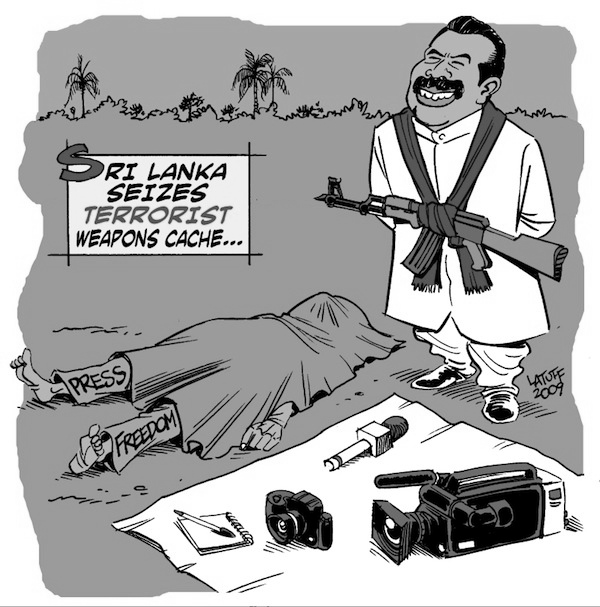
The Reckoning: Press Freedom in Sri Lanka


Cartoon by Carlos Latuff
“The freedom to speak and the freedom to write are essential preconditions for the transition towards democracy and good governance” –  Irina Bokova, the Director-General of UNESCO.

We are living in the world, in which committed journalists writes the news not only with ink, but also with their blood. This is the very reason that their souls still exists with us even after their tragic deaths. Sri Lanka is the very recent example for such context.  Thirty-four journalists and media workers have been killed with no recourse to justice since the United Peoples Freedom Alliance (UPFA) government came into power in April 2004 with the present President Mahinda Rajapaksa as its prime minister. [1] This list does not include the comprehensive details of the journalist and media workers who were killed in Vanni during the last phase of the war (North of Sri Lanka), which was labeled as “world’s largest rescue operation”.

May 11, 2011

A Mother’s Call for the Re-awakening


                                                             Photo credit: Sangam
Mrs. B. Thilagamani began her non-violent resistant activism when she was 18 years old and played a key role during the 1961 Satyagraha Campaign. During the Satyagraha Campaign, Sri Lankan Armed Forces (SLAF) brutally retaliated against non-violent campaigners. In their terror campaign of 18 April 1961, Thilagamani was sprayed with SLAF tear gas and her sari was partly burnt. Today, 18 April 2011, marks her 50 symbolic years in non-violent activism.

Feb 18, 2011

The Tamil Diaspora and the Future of the Tamil Struggle


Today, the 18th of February, finds us three months away from the second anniversary of the “Mullivaikal Massacre”. At this juncture it is important to ask the question: What constructive action can be taken by the Tamil Diaspora to build a better future for the Tamil nation?


In Tamil culture, at a funeral, all the people of the village are expected to attend. It’s tradition. But if the whole village was a funeral house, who will go and to whose house?  Also, who will heal the existing souls?

Dec 24, 2010

An Era of Sri Lanka’s President: From Mullivaikal to Oxford Union


[Authors note: Mullivaikal is where the last phase of the war between Sri Lankan Armed Forces (SLAF) and Liberation Tiger of TamilEelam (LTTE) took place.  According to the Government of Sri Lanka, this was the place war came to an end with the military defeat of LTTE, but for majority Tamils and international human rights activists, this was the place at-least 30000-40000 Tamil civilians were massacred by SLAF. The ‘controversy’ began from here and continues even after 19 months.]

Sep 30, 2010

My Shattered Dreams - “We will meet in three days”


I
It was April 21, 2006.

The final day in my home and on my soil.

The final minutes I spent with my dad.

The last time I saw my mum and dad together.

My final activity in Jaffna[1].

My last direct initiative in the North part of the Island.

My final good bye to Jaffna in that atmosphere.

That was the final day I saw many of my friends.

Would it be possible to see at least my mum in our home again? Or was it my last journey in Jaffna?

Just before I left the house, I wanted to say bye to “Appa” (dad[2]), but he was at the prayer room. When I moved the curtain, he noticed me and said “take care of yourself, we will talk in three days once you returned “and waved his hand.

As always, “amma” (mum) came with me to the gate and waited till I got on the bus to Jaffna.I went to Jaffna, in order to show my solidarity at the Consortium of Humanitarian Agencies (CHA) workshop before I headed to a meeting at my head office in Colombo.  After an hour, I said bye to the participants and organisers and left the auditorium.  Thereafter, I entered into my branch office and did the final preparations for the meetings the following day at my head office in Colombo.

I left the room once I was satisfied with my preparation and said bye to the management of the building. So many “byes”, but I didn't expect at the time that these were my final good byes in Jaffna.

As I had to attend the CHA workshop, I decided to travel via land route to Colombo. I came to the bus stand, which was near the Jaffna district government secretariat, to take the bus to Muhamalai[3]. Usually, there were buses at-least every 15 minutes during weekdays, but strangely, there were no buses for more than an hour especially on that day and particular time.

I now realise my soil wanted to keep my steps on her as long as possible. The wind tied its freshness around me. I felt something, but I never thought that was my final moment with my people on our soil.

Finally, the bus arrived and I got in with my small shoulder bag as I have to stay only two days in Colombo. I was planning to return to Jaffna afterwards in order to bring together the North Ceylon Journalist Association and the Jaffna Journalist Association as the united journalist structure in Jaffna district to face future challenges and strengthen democratic voices.  (I took this initiative in early January. At last my mediation succeeded with the support of the key people of both organisations    After almost 95 percent working mechanism was completed and a new set up emerged, we decided to announce the completion soon after my return from Colombo, although later I heard of one or two people opposing to bring both organisations together [4]).

I arrived in Colombo on the same day and attended the Monday (23rd) staff meeting. I was supposed to go back to Jaffna after the meeting via flight as I have to meet the members of the journalists associations, but my coordinator asked me to extend the stay due to another meeting. Therefore, I decided to stay and informed the relevant people concerning the postponing.

During my brief at the meeting, I recalled Prof. Cheran’s poem, “On the clouds…fire has written its tale” and gave a short analysis about the worsening situation. According to the rearranged schedule, I had to leave on the 26th of April, 2006, but that days’ blast cancelled my journey back to Jaffna as all transportation routes to Jaffna were stopped until further notice.   Since then, I have never been back to Jaffna due to volatile security situation, which was a personally threat for me as well.

My life in Colombo was very dramatic, which I will write about on another occasion. Some of that memory is written under the title of “The Life in An Open Prison” in another paper. The constant pathetic situation forced me to leave the country. I decided to see my parents before I had to leave Sri Lanka, but I could not go to where they were. Therefore, I invited them to Colombo. After few days, mum told me that “they (military) will provide defence clearance for one person only, either for me or appa”.  Some minutes after silence, I told her to come to Colombo, because I thought my dad is a healthier person and I can see him upon my return, which I hoped would happen in maximum one year. My mothers’ health concerned me, as she cannot live without medicine; most of her days spent in hospital and with treatments. When my mother arrived in Colombo we were extremely happy to meet each other; I was with her twenty two days. These were unforgettable days in my life.

Then, with hugs and bye to my mum, I left Sri Lanka on the 30th of September, 2008; in reply mum gave me blessings.  

Of course! I saw the tears in her eyes, when we said goodbye to each other. Again and again I told her to take care of her and my fathers’ health condition.  I conveyed a message to dad through mum, and also sent a letter after I arrived in Europe about my concern with regard to both of them, my studies and other things.

I was counting the days to return, but before I could go back, the message came to me.


II


A message of my fathers’ death (17 January2009, around 12:30 am).

I am still shocked when I think about my fathers’ death. Our family never expected his death so soon as he was the healthier person in our family. After the 2002 Cease fire Agreement (CFA), I saw my parents after five years and stayed with them about one week. Just before I had to leave for Colombo again, my father told me, “As you became a journalist, you need to be more careful. If either of us, I or “amma” (mum) die, wherever you are, don’t miss to come and keep the fire / embers [5] (kolli) (Kavanam appu, enkai irunthalum kolli vaika vanthidu) on me or her during the cremation.” I replied to soften the conversation, “Dad, you are strong enough, you will live for long time, you will die after me only”.  He replied: “Don’t talk like that, even as a joke. Nothing bad will happen to you”.

I know my parents were worried about me since I started my journalism career, but I thought I could stay with my parents for long time as Cease Fire Agreement was signed between the Government of Sri Lanka and Liberation Tigers of Tamil Eelam. However, neither of these things took place: my long stay with my parents or the final fire on my dad’s cremation ceremony. Remarkably, the CFA went through a coma stage and finally died. 

I tried to go to my dad’s funeral, but I wasn’t able to do so as I was warned that guns were targeting me as my pen had been too vibrant. I remember, usually in the evenings during my childhood, dad carried me on his shoulder to the playground, temple and relatives’ house. Once I met him after five years and gave some amount of money from my first salary. I had stored this money for some time so that I could give it to my parents first. Upon giving him the money I told him, “Dad, you carried me on your shoulders in my childhood. Now, you are getting older and shouldn’t do any hard things, now I can carry your responsibilities.” Unfortunately, I couldn’t even fulfil his desire of keeping embers on his body during his cremation. Still, our souls are deeply connected and this event will be forever with me. 

I couldn’t fulfil my dad’s humble expectation…..On the “Thai Pongkal” day, I talked to dad, which was the final conversation between us. As he lost his hearing power, he didn’t understand what I said. However, as other times, he said he is fine, but that my mum is constantly taking medicine and not that well. He asked me to tell her not to fast so much, as it is worsening her health condition. “We are deeply missing you, and would love to see you. A few days ago I posted a letter for you where I wrote some important things to you; to have your foods on time and take care of yourself, we are helpless to help you as you are alone there”. 

I told my mum that now she should reduce her fasting as her health condition is in a weakened state; my sister also said the same thing to mum. She answered that she will do it gradually. I told her to tell dad (as he could not hear what I said over the phone) that I sent some of my photographs through a cousin of mine, which dad could see in a few days. She said, “I also looking forward to see that and will tell dad”, then she added, “after a long time Appa was so enthusiastic to do the Thai Pongkal festival and it went very well, but we missed you very much”.   I told her that I am glad to hear that both of them had a great time and that I was happy about their Thai Pongkal celebration. I said they should not worry as I will be there for the next Thai Pongkal. Our conversation came to an end after her describing the joyful festivities of the Thai Pongkal festival. That was the last “Thai Pongkal” my mum celebrated with dad.

I was eagerly waiting for my father’s letter, which I didn’t receive even after nearly twenty one months. My mum told me that father was waiting to see my pictures but nothing happened. However, dad is not with us anymore; he died just before my cousin brought my photos to him.

The irreparable loss happened during very early hours (around 12.30am) of January 17, 2009.

My mum didn’t know about dad’s death for the first five days. Dad got chest pain while he was watching television at our neighbour’s house, who is our close relative. According to them dad suddenly touched his chest and didn’t say anything. Immediately, our relatives called mum, who was ready to enter into the bathroom. Along with my mum, some of my relatives took dad to nearest base hospital. Soon after dad was hospitalised  mum informed me, my sister, uncle and aunts.

When mum called me, I was discussing with a foreign journalist in Germany how to prevent the expected bloodbath. After she called, I realised that she was in panic and nervous, but she said: “I hope he will be fine”. After the discussion with the journalist, I traveled to Switzerland. As I arrived in Switzerland, my mum called me again and said that my dad’s situation was not improving, therefore the doctors advised her to take him to the Jaffna hospital in an ambulance. They did the arrangements and dad was taken to Jaffna hospital.   

Few minutes after mum got down from the ambulance she fainted. Then, both of my parents were hospitalised  but neither dad nor mum realised any of it. After a few hours, my dad left without telling us: he passed away. 

Since I heard of the death of my father, I was trying to talk to mum, but couldn’t succeeded as she was also admitted to the Intensive Care Unit. I think it was after two days that I finally could speak to her. She told me as follows: “Appu[6],  Appa (dad) was admitted to the males ward, I bought a juice for him, which he like very much, but doctors and nurses didn’t allow me to go there and give it to dad. Can you talk to them to allow me to give the juice to dad? Also, he didn’t see me for long time and he will worry as I am hospitalised  If I visit him, he will be happy, you know that. Please explain this to the doctors”. 

What I can reply to her??? I was silenced. Whilst controlling my tears, I told her a lie, “Mum, dad is ok, don’t worry, take care of yourself. Sister will be with you very soon”. Even, she couldn’t talk properly; she asked me, “Why sister is coming, tell her not to come here, the situation is not good”.   I replied that both of them are now at the hospital and my sister wanted to come and see both of them. (Actually, sister wanted to go and see parent’s long time back, but due to the volatile situation in the country, she couldn’t make it.)  We decided to tell my mum about dad’s death through my sister once she arrived there, which would be better to ease my mum’s pain. My sister went to our home after twenty years and saw dad’s dead body. We didn’t meet each other the last twenty years.  

As dad condition was getting critical, I got some strange impression and I was at an unprecedented mindset.  Two of my friends (both of them are my close relatives) tried to calm me down. They asked me to go the church, where they have immense belief and told me that some of their friends went through some similar situations and went to the church to get God’s blessings.  So I also went to the church and begged God, but this time God also couldn't help me or, I think, dad died just before I entered the church.

I was on my way back home as I got a call from Jaffna. It was about 12.30am there. I could sense my cousin was panicking and was very reluctant to talk. I realised the situation, and she told me: “Nishan Anna[7], unakadai appa (your dad)…” She couldn’t continue. My voice changed, but didn’t shake. I asked her: “You mean, Dad is not with us anymore?” She said yes and talked in an empathic way. I told her don’t worry about me, please take care of mum. Soon after I kept the phone, my mind went back to wonderful memories of my dad and I from childhood and until I was with him last.

Dad’s death has been the hardest time in my life, but I haven’t shed tears properly until now. I was online during the funeral time, while the candles were being lit. I heard my mum and sister’s cries and lament, which shook me too. Apart from this, I cried slightly in two other occasions, which were when I wrote a poem for dad’s funeral (later people said, they cried not only about dad’s death, but due to my poem as well) and when I started to write this piece of reflections.

I wanted to cry for my dad properly. Indeed, I will cry for him one day… but this is not the time for that. There are moral responsibilities which I have to do. I couldn’t go to my dad’s funeral, I couldn’t put the embers on my dad, I couldn’t be with mum during her hardest time, which I feel occurred by injustice.  What happened to me shouldn’t happen for others. I have a strong moral sense that my struggle for justice will win one day. Then, I will cry as the way I wanted. Otherwise, my dad’s moral bond to me won’t accept my cry. I think my dad approves of my decision, because my parents often said that I was born on the day of “Sooran Poar”, which means the day injustice was defeated.

If the justice prevails, I will go home. I will see mum at our home, I will enter into the prayer room, where I saw dad the last time. There is a framed photo of dad with his unique smile and I will cry and pay my final respect, while holding my mum hands.

Until justice prevails, my struggle will continue against injustice.

NB: I have decided to write this article as I left Sri Lanka on this day (September 30, 2010) two years ago without a chance to see my dad.


[1] Jaffan is a district in the northern part of the island nation
[2] He cannot hear properly, after he was got in a Sri Lankan military attack in 1987 
[3] Entry / exit point of Jaffna, which was the border between the military and LTTE controlled territory.
[4] I will explain more about this imitative at right time
[5] According to the Hindu culture, during his dad or mum crimination time, their son will put ember on the death body, after rounding and praying his dad or mum. In circumstances, other also can do, but parents always wanted their son to do it.  Sons’ feel this is there major responsibility and parents feel as a great satisfaction. (There are in-depth note on it with different perspective)
[6] Some of Tamil parents call their son like that with deep love and great kindness
[7] My relatives and childhood friends call me as Nishan and Anna means elder brother.


Design by Free WordPress Themes | Bloggerized by Lasantha - Premium Blogger Themes | cheap international voip calls